


The Non-Interest Financial Institutions Association of Nigeria

Nigeria's non-interest finance industry has one voice.

NIFIAN unites the banks, fund managers and takaful operators building a ₦5.77 trillion Shariah-compliant financial system — regulated, transparent, and open to every Nigerian.

Growth you can measure. Ethics you can verify.

Non-interest banking assets in Nigeria more than doubled year-on-year to end-2024. Behind that number are institutions that finance real assets, share real risk, and answer to the CBN, SEC and NAICOM.

Finance that has to touch something real.

Every naira our members deploy is tied to an asset, a trade or a partnership — a farm in Kaduna, a shop in Kano, a road in Lagos. That is the difference, and it is why the 26% of Nigerian adults still outside the financial system matter to us.

Scroll to explore
Nigerian financial professionals in traditional dress meeting around a boardroom table in Kaduna
₦5.77trn Total Nigerian non-interest finance industry, end-2025

Who we are

One industry, one table, one voice.

Non-interest finance in Nigeria did not arrive as a single institution. It arrived as a fund manager in 2004, a bank in 2012, a takaful window in 2010, a sovereign sukuk in 2017 — each building its own market, each negotiating with regulators alone.

NIFIAN exists because that is no longer good enough for an industry this size.

We are the association of Nigeria's licensed non-interest financial institutions. Our members are the banks, capital market operators and takaful companies that run on profit-sharing and asset-backed contracts rather than interest. Together they manage a market that closed 2025 at ₦5.77 trillion.

What we do with that collective weight is straightforward. We take one position to the regulator instead of nine. We train the professionals the industry cannot hire because they do not yet exist. We explain, patiently and repeatedly, that non-interest finance is an ethical model open to Nigerians of every faith — not a product for one community.

Read our full story

The market, in numbers

Numbers that speak.

Nigeria's non-interest finance industry is no longer a niche. Here is where it stood at the end of 2025.

0trn
Total industry size
End-2025
0trn
Non-interest banking assets
65.5% of the industry
0trn
Sovereign sukuk outstanding
~74% of the non-interest capital market
0
FGN sovereign sukuk issuances
Since the debut issue in 2017
0%
Peak sukuk oversubscription
₦2.2trn in total subscriptions to date
0%
Non-interest banking asset growth
Year-on-year to end-2024
0
Licensed non-interest banks
Plus non-interest windows
0
NIFIAN member institutions
Banks, fund managers, takaful operators

Sources: Central Bank of Nigeria, Debt Management Office, Fitch Ratings and NIFIAN analysis. Full sourcing on our Fact Sheet.

The sectors we represent

Four markets. One set of principles.

Non-interest finance is not one product. It is a full financial system with its own banking, capital markets, insurance and asset management — each governed by the same rule: money must be tied to real assets and real risk.

A young Nigerian man in traditional dress using his phone beside a shop front in a Nigerian town

Non-interest banking

Nigeria has four fully licensed non-interest banks and a growing set of non-interest windows inside conventional banks. They take deposits, finance homes, cars, trade and working capital — but never by lending money at interest. Instead they buy and sell assets (murabaha), lease them (ijara), or go into partnership with the customer (musharakah).

₦3.78trn in assets · 65.5% of the industry See the banks
A high-rise building under construction on the Lagos waterfront

Sukuk and capital markets

Sukuk are investment certificates backed by real assets — the holder owns a share of a road, a bridge, a building, and earns rent from it. Nigeria has issued seven sovereign sukuk since 2017, raising over ₦1.39 trillion for road and infrastructure projects across all six geopolitical zones, and attracting ₦2.2 trillion in total subscriptions.

₦1.19trn outstanding · 7 sovereign issues See our capital market members
A senior Black businesswoman in a headwrap reviewing documents beside an office window

Takaful

Takaful is mutual protection. Participants contribute to a shared pool, claims are paid from that pool, and any surplus goes back to the participants rather than to shareholders. Nigeria's takaful operators are licensed and supervised by NAICOM, and cover motor, engineering, asset protection, group schemes, credit, mortgage protection and family plans.

NAICOM-licensed · Surplus returned to participants See the takaful operators
A Black executive in a business suit walking past an institutional building

Ethical asset and fund management

SEC-registered Shariah-compliant fund managers screen out interest, gambling, alcohol, tobacco and conventional insurance, and invest in the businesses that remain. In 2025, Shariah-compliant equity funds in Nigeria returned 14–16% to investors. Several of these funds are listed on the Nigerian Exchange and open to any investor, of any faith, from as little as a few thousand naira.

14–16% returns on Shariah equity funds in 2025 See our fund managers
1 / 4 Scroll or swipe

Our members

The institutions building this market.

Nine licensed institutions. Four non-interest banks, three ethical asset managers, two takaful operators — every one of them regulated in Nigeria, and every one of them a NIFIAN member.

The model, explained

What makes finance “non-interest”?

Non-interest finance is a regulated financial model in which institutions earn returns from trade, leasing, partnership and asset ownership rather than from charging interest. Every transaction is tied to a real asset or productive activity, risk is shared between the institution and the customer, and speculative or harmful sectors are excluded.
Intricate Islamic geometric and calligraphic patterning on a domed ceiling

By buying and selling, leasing, and partnering. In a murabaha, the bank buys the asset the customer wants and resells it to them at an agreed mark-up, payable in instalments — the profit is disclosed up front and never changes. In an ijara, the bank owns the asset and leases it. In a musharakah, the bank and customer both put in capital and share the profit or loss by agreement. In every case the bank has to own something and carry some risk before it can earn anything.

No. Non-interest banks in Nigeria are licensed by the Central Bank of Nigeria as conventional financial institutions operating under a non-interest model, and they serve customers of every faith. As one of our past presidents put it, non-interest banking “appeals to all and is not a discriminatory financial product.” A large share of customers choose it for the pricing transparency and the fixed, disclosed profit rate rather than for religious reasons.

Yes, comprehensively. Non-interest banks are licensed and supervised by the Central Bank of Nigeria under the Banks and Other Financial Institutions Act and the CBN's non-interest banking guidelines. Non-interest fund managers are registered with the Securities and Exchange Commission. Takaful operators are licensed by the National Insurance Commission. Deposits are protected under the NDIC's non-interest deposit insurance scheme, and the Federal Government has itself issued seven sovereign sukuk since 2017.

Every non-interest institution in Nigeria must have an Advisory Committee of Experts (ACE) — an independent panel of scholars qualified in both Islamic commercial jurisprudence and finance. The ACE reviews and approves every product before launch and audits transactions afterwards. Above the institutions sits the CBN's Financial Regulation Advisory Council of Experts (FRACE), which sets the national position. NIFIAN's role is to help harmonise practice between them, so a murabaha means the same thing at every member institution.

A bond is a loan: you lend money and are paid interest. A sukuk is ownership: you buy a share in an asset and are paid rent or profit generated by that asset. If the asset underperforms, the sukuk holder's return changes; a bondholder's coupon does not. That is why Nigeria's sovereign sukuk are tied to named road projects — the certificates are backed by the roads themselves.

It stays uninvested, or goes to charity. Non-interest institutions cannot park surplus funds in interest-bearing instruments, which historically left them holding idle cash. This is the industry's single biggest structural challenge, and it is why NIFIAN worked with the CBN on new Shariah-compliant liquidity instruments — a non-interest master repurchase agreement, non-interest asset-backed securities and non-interest notes. Any income that is inadvertently interest-based is purified: stripped out and donated, never booked as profit.

Learn how it works
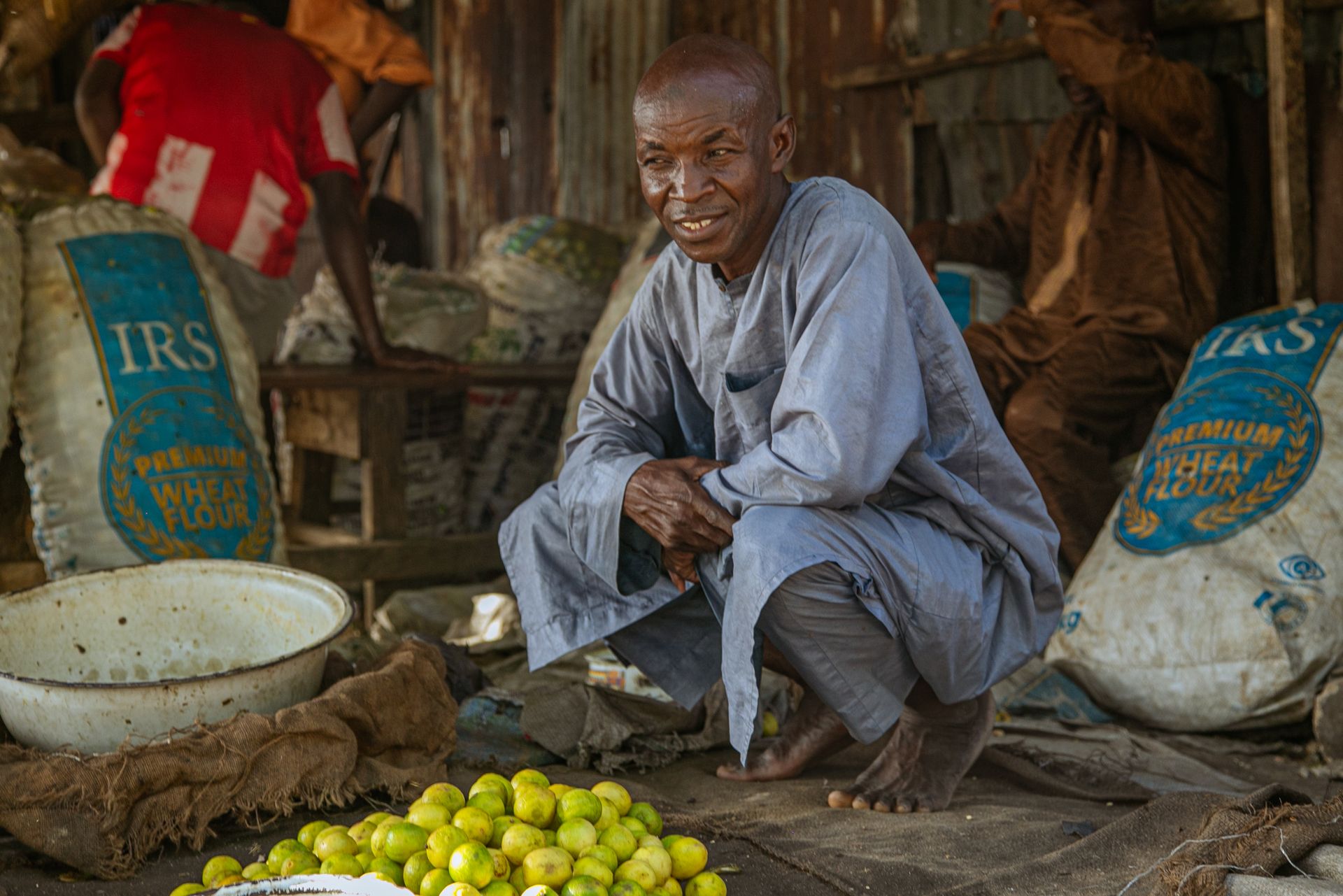
An elderly trader in his stall in a Maiduguri market, surrounded by grain sacks and produce
A farmer standing in a green rice field in northern Nigeria

Why it matters

26% of Nigerian adults are still outside the financial system. Many of them are outside it on purpose.

EFInA's 2023 Access to Financial Services survey found that 26% of Nigerian adults are financially excluded. The gap is not evenly spread: exclusion runs at 47% in the North West and 38% in the North East, against 5% in the South West.

Some of that gap is infrastructure — no branch, no agent, no network. But a meaningful portion of it is a decision. Millions of Nigerians have looked at conventional banking, concluded that interest-based products are not acceptable to them, and chosen to keep their money in cash, livestock or informal savings groups instead.

You cannot fix that with more branches. You fix it by offering something people can actually use.

That is the case for non-interest finance in Nigeria, and it is the reason NIFIAN's work is not simply commercial. Every product our members design for a farmer in Katsina, a trader in Kano or an SME in Kaduna moves someone from the informal economy into the regulated one — where their savings are insured, their credit history is recorded, and their business can grow.

0%of Nigerian adults financially excluded — EFInA, 2023
0%exclusion rate in the North West — the highest in the country
0%overall financial inclusion, up from 68% in 2020
How we drive inclusion

FAQ

Frequently asked questions

NIFIAN is the Non-Interest Financial Institutions Association of Nigeria, the umbrella body for licensed Shariah-compliant financial institutions in the country. Its members include non-interest banks, SEC-registered ethical fund managers and NAICOM-licensed takaful operators. NIFIAN represents the industry to regulators, runs professional training, and promotes public understanding of non-interest finance.

Nigeria has four fully licensed non-interest banks — Jaiz Bank, LOTUS Bank, TAJBank and The Alternative Bank — alongside non-interest windows operated within conventional banks. All four are NIFIAN members and are licensed and supervised by the Central Bank of Nigeria.

Nigeria's non-interest finance industry closed 2025 at approximately ₦5.77 trillion. Non-interest banking assets accounted for ₦3.78 trillion, or 65.5% of the total, while sovereign sukuk outstanding stood at about ₦1.19 trillion. Fitch Ratings estimated the industry at around US$4 billion as at May 2025.

No. Non-interest banks in Nigeria serve customers of every faith and are regulated in exactly the same framework as other Nigerian banks. Many customers choose non-interest products for the fixed, disclosed profit rate and the absence of charges that compound if you fall behind, rather than for religious reasons.

Three regulators share the mandate. The Central Bank of Nigeria licenses and supervises non-interest banks. The Securities and Exchange Commission registers Shariah-compliant fund managers and non-interest capital market products. The National Insurance Commission licenses takaful operators. Deposits at non-interest banks are insured by the NDIC.

Institutions apply through the membership form on the Join NIFIAN page. Applications require evidence of a valid Nigerian operating licence from the CBN, SEC or NAICOM, a profile of the institution's non-interest operations, and details of its Advisory Committee of Experts. The Secretariat reviews applications and the Executive Committee ratifies admissions.

Your institution should be in this room.

If your bank, fund, takaful operator, fintech or advisory firm works in non-interest finance in Nigeria, NIFIAN membership puts you at the table where the industry's positions are agreed — before they reach the regulator.